


Authors: Priska Maya, Zahra Mustafavi
Reviewers: Farid Al-Firdaus, Dwi Martutiningrum, Dinda Ganisawati Javada
The Vision of Golden Indonesia 2045 aims to transform Indonesia into a developed nation by its centennial. A key aspect of this vision is improving public health and quality of life. Good health is vital for national productivity and is a fundamental right.
Currently, Indonesia faces numerous health challenges, including longstanding issues like malnutrition and stunting, compounded by rising consumption of ultra-processed foods (UPF). These foods, high in sugar, salt, fat, and artificial additives, lack essential nutrients.
The Indonesian government has set ambitious health targets, including reducing toddler stunting to 5% by 2045. However, achieving this goal is challenged by prevalent consumption patterns of UPFs, contributing to high malnutrition (9.3%) and stunting rates (30.8%) in 2018 (Colozza et al., 2022).
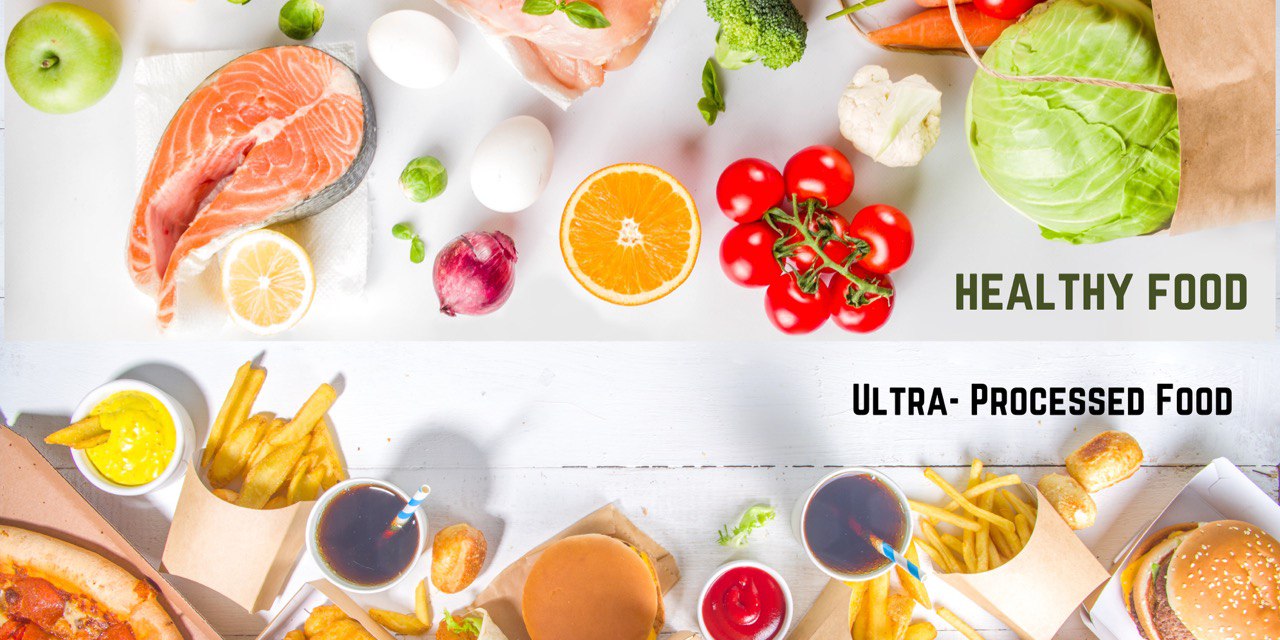
Ultra- Processed Food
Optimal health, intelligence, creativity, and overall well-being are strongly linked to balanced and high-quality nutrition from an early age. One of the best sources of nutrients comes from minimally processed, whole foods. However, modern dietary patterns have shifted, with a growing reliance on UPFs rather than real food. This shift poses serious health concerns, particularly for children.
UPF is a food product that undergoes complex industrial processing, which causes significant changes to the original form and naturalness of the food ingredients. UPF products generally contain additional components, such as salt, sugar, oil, fat, and synthetic ingredients such as antioxidants, preservatives, dyes, and stabilizers. According to research by Chen et al. (2020) in the Nutrition Journal, these UPF have lower nutritional content and frequent consumption of UPF in large portions can increase the risk of death from degenerative diseases such as high blood pressure (hypertension), coronary heart disease, excess weight, and other metabolic syndrome diseases that are at risk of death.

Picture 1. NOVA Food Classification
Source: https://www.theurbanco-op.ie/blogs/nova-food-classification
The Impact on the Golden Age
In Indonesia, the rising consumption of UPF due to urbanization and lifestyle changes contributes to significant public health concerns (Setyowati et al. 2018). Found that approximately 19.5% of the daily energy intake in Indonesia comes from UPF, with DKI Jakarta recording the highest UPF consumption in the country. This increase is closely linked to the growing prevalence of non-communicable diseases, such as diabetes, heart disease, and cancer. Data from Basic Health Research (Riskesdas 2018) reveals that Jakarta also has the highest obesity rate at 45.4%, along with high rates of other chronic diseases.
The First 1,000 Days of Life (HPK) is a critical developmental window for children, during which proper nutrition is vital for laying the foundation for lifelong health. However, the 2021 UNICEF report on children’s nutritional status indicates that many Indonesian children, particularly those aged 6-8 months, do not receive adequate solid food. In the 6-23 month age group, 48% of children are not fed according to recommended guidelines, and 71% lack sufficient dietary variety.
In 2017, the Individual Consumption Survey in Jakarta, which involved 1,605 individuals, found that 41.4% of children aged 0-4 years consumed UPF, with an average intake of 218 grams per day.

Picture 2. Consumption of UPF in Jakarta
Sources : The Individual consumption survey, Jakarta 2017
A more recent 2024 survey of 58 households revealed that 92%of parents gave UPF to children in this age group. The most frequently consumed products included formula milk (15.38%), biscuits (13.9%), and packaged bread (9.44%)
While formula milk was typically given daily, other UPFs like biscuits and packaged bread were consumed about once a week.

Picture 3. UPF Category
Source: primary research data processed by the researchers
The primary reasons parents cited for providing UPFs were convenience, including faster cooking time (24%) and ease of serving (24%). Additionally, 6% of parents were influenced by external factors such as food assistance programs or doctor recommendations.
The shift towards UPF consumption during the critical HPK phase has several adverse effects. It is associated with lower breastfeeding initiation rates, shorter durations of exclusive breastfeeding, and premature cessation of breastfeeding before the recommended two-year mark (Khandpur et al. 2020).
Highlight that UPF consumption during early childhood is linked to micronutrient deficiencies, overweight, and obesity.
This period is crucial for rapid growth and brain development, making nutrient-dense foods essential. However, replacing natural, whole foods with UPFs compromises the nutritional quality of children’s diets, making it more challenging to achieve Indonesia’s stunting reduction target of 5% by 2045.
Addressing this issue through improved education and dietary guidelines is essential to ensure the health and development of future generations.
Policy Recommendations
- Public Awareness Campaigns: Comprehensive campaigns should be launched to educate the public on the dangers of UPFs and the importance of nutrient-rich, whole foods. These campaigns can utilize various media platforms to ensure a broad reach.
- Community Education: Seminars, workshops, and community events can help parents and caregivers better understand the risks associated with UPFs and encourage healthier food choices. Health centers and clinics should offer education programs focused on nutrition and child development.
- Early Childhood Nutrition Programs: Integrating nutrition education into early childhood health programs is crucial. Schools should adopt policies that promote balanced meals and prohibit the consumption of UPFs, particularly those high in sugar and salt.
- Regulation of UPF Marketing: Stronger regulations on UPF marketing, especially those targeting children, are necessary. This includes restricting the use of cartoon characters and other tactics that appeal to young children. Additionally, clearer front-of-pack nutritional labeling can help consumers make more informed decisions.
- Fiscal Policies: Introducing taxes on high-energy UPFs could serve as a deterrent, encouraging consumers to choose healthier options. Governments should also regulate claims made on food packaging to ensure transparency about the product’s nutritional content.
Conclusion
The increasing consumption of ultra-processed foods, particularly among young children in Indonesia, poses a significant threat to the nation’s long-term health goals. If left unaddressed, the current trends in UPF consumption could undermine efforts to reduce malnutrition and stunting, both of which are critical for achieving the Vision of Golden Indonesia 2045.
Public education, regulatory measures, and supportive policies must be implemented to reduce UPF consumption and promote healthier dietary habits, ensuring that future generations grow up in optimal health.
REFERENCE
Ministry of Health of Indonesia. Total Diet Study Book: Individual Food Consumption Survey 2014. Jakarta: Litbangkes Publishing Institute; 2014.
Levine, S Allen, Job Ubbink. UPF: Processing Versus Formulation. National Library of Medicine: August 2023 https://www.ncbi.nlm.nih.gov/pmc/articles/PMC10399516/
Syatira, Atira and Ekaria. The Effects of Price Income and Household Characteristics on Ultra-Processed Food Consumption in Jakarta, Indonesia. Journal of Statistics Applications & Statistical Computation: 2022 https://jurnal.stis.ac.id/index.php/jurnalasks/article/view/386/111
Setyowati, Dyah et al. Processed and ultra-processed food consumption patterns in the Jakarta Individual Food Consumption Survey 2014. Asia Pac J Clin Nutr : 2018 https://apjcn.nhri.org.tw/server/APJCN/27/4/840.pdf
Unicef Data. Fed to Fail: The crisis of children’s diets in early life. 2021. https://data.unicef.org/resources/fed-to-fail-2021-child-nutrition-report/
Widodo, Yekti. Ministry of Health, New Born Infant Feeding Habits in Central Java and West Java: 2021. https://repository.badankebijakan.kemkes.go.id/id/eprint/1030/1/678-1796-1-PB.pdf
Pratiwi, Azizah Ajeng, Chandra, Dian Novita. Faculty of Medicine, University of Indonesia. Ultra-processed food and its correlation with body mass index for age among 10-12 years old school children in Surabaya: 2021 https://lib.ui.ac.id/detail?id=20514250&location=lokal
Colozza, David. A qualitative exploration of UPF consumption and eating out behaviors in an Indonesian urban food environment: 2022. https://journals.sagepub.com/doi/10.1177/02601060221133897
De Oliveira, Priscila Gomez, et al. Impacts of Consumption of UPF on Maternal-Child Health: A Systematic Review: 2022. https://www.ncbi.nlm.nih.gov/pmc/articles/PMC9136982/
Waitzman, Eren. Impact of ultra-processed food on children’s health: 2023. https://lordslibrary.parliament.uk/impact-of-ultra-processed-food-on-childrens-health/
Chang, Kiara, et al. Association Between Childhood Consumption of Ultra Processed Food and Adiposity Trajectories in the Avon Longitudinal Study of Parents and Children Birth Cohort: 2021. https://pubmed.ncbi.nlm.nih.gov/34125152/
Khandpur, Neha. Ultra-Processed Food Consumption among the Pediatric Population: An Overview and Call to Action from the European Childhood Obesity Group: 2020. https://karger-com.translate.goog/anm/article/76/2/109/42739/Ultra-Processed-Food-Consumption-among-the?_x_tr_sl=en&_x_tr_tl=en&_x_tr_hl=en&_x_tr_pto=tc
https://www.ncbi.nlm.nih.gov/pmc/articles/PMC8217149/pdf/nihms-1681305.pdf